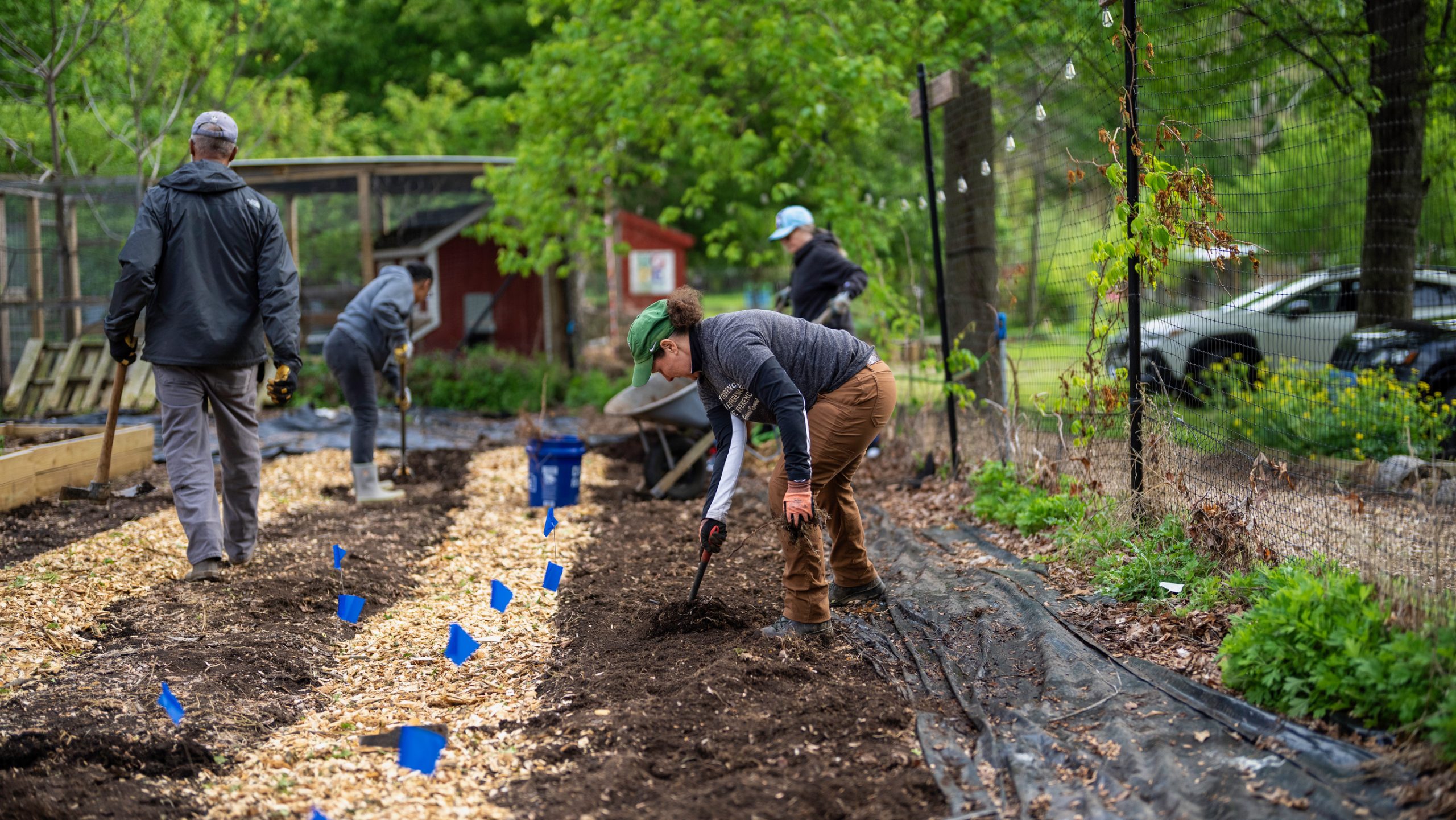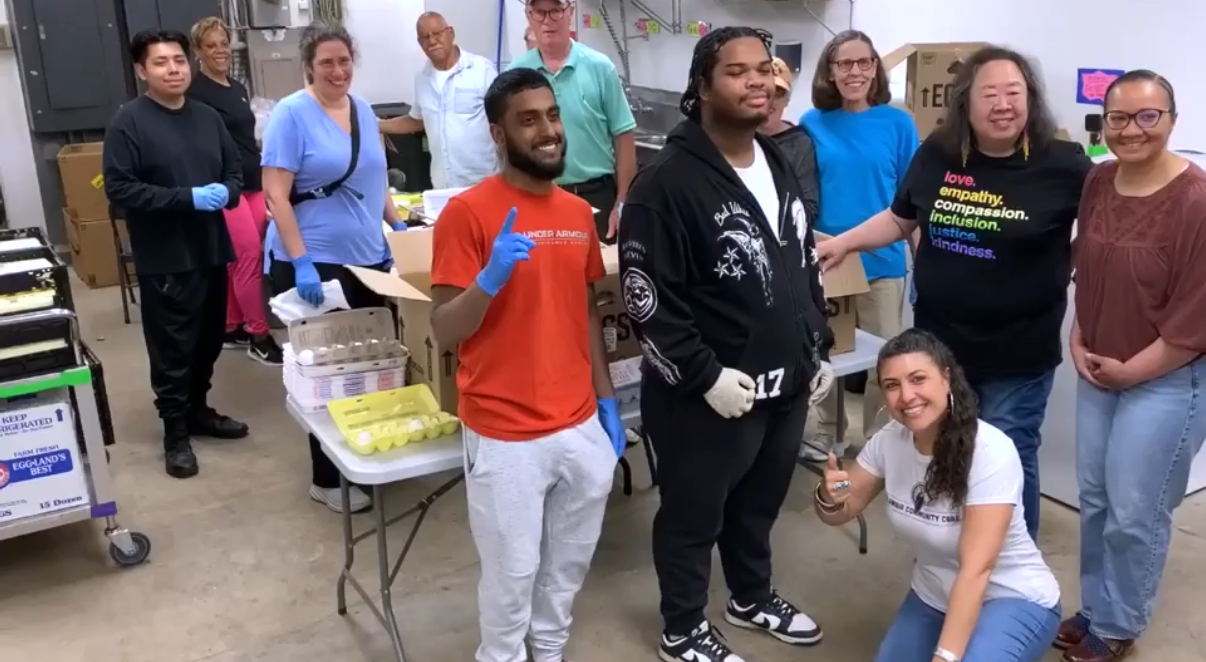
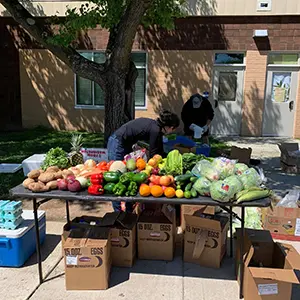
It was March 2020, the world had just stopped, and Carrie Ross had just moved back to Howard County from Seattle with no job and no clear direction. Like a lot of people that spring, she turned to Facebook, scrolling through community groups, trying to get a feel for the place she’d landed. That’s where she first saw Columbia Community Care (CCC). She showed up to volunteer, saw the warmth in how Erika Chavarria ran her Saturday distribution, the absence of paperwork, the way people were treated, and she kept coming back.
Six months later, Carrie took a leadership role overseeing the Howard County Food Bank, which is owned and operated by the Community Action Council of Howard County (CAC). Since then, as the Director of Food Bank Services for CAC, she has worked closely with CCC as a collaborative community partner.
“I’ve been in the nonprofit world for 20 years,” she said, “and people always assume CCC is a competitor. But that’s not what we do. We support each other. It takes all different types of organizations to get a problem solved.”
The Paradox in Plain Sight
On the surface and on paper, Howard County is one of the wealthiest counties in the country. Hunger is often invisible here, and many residents don’t even realize the extent to which families struggle to make ends meet.
Tracy Broccolino, president of CAC, sees the reality of this paradox every day.
For more than 60 years, CAC has served as Howard County’s federally designated anti-poverty organization. As part of a nationwide network of Community Action Agencies, CAC helps hardworking individuals and families access food assistance, early childhood education, housing support, energy assistance, and weatherization services that promote long-term stability and economic mobility.
Tracy has watched the county build a reputation as an affluent, high-achieving community even as economic hardship has intensified for many residents.
“Poverty here takes a different form than people expect,” she said. “It doesn’t announce itself. People who are struggling to make ends meet are living in the same neighborhoods and going to the same schools as everyone else. The first thing people stop doing is eating. A parent will stop eating so their kids can eat, so they can keep a roof over their heads or make their car payment.”
CAC’s 2023 Community Needs Assessment, a rigorous triennial analysis of poverty’s causes and conditions across Howard County, identified food access and food security as one of the county’s top priorities. While food may be physically available, the high cost of housing and daily living expenses often leaves little room in a family budget for groceries.
Carrie frames it simply: “The house eats first. You pay rent, utilities, transportation because those consequences are immediate. Food ends up at the bottom of the list. And so does health care.” Parents are skipping meals so that children can eat and postponing medical care or medication to ensure bills get paid.
When Carrie started at the food bank in 2020, their average client was often a senior on a fixed income. Today, many clients are working adults between the ages of 18 and 45 who are educated, employed, often working multiple jobs, raising children while balancing rising costs. She’s your neighbor. She’s the person checking you in at the doctor’s office or behind the counter at lunch. And she is one unexpected expense – a car repair, a home maintenance issue, or time off work for an illness – away from a crisis.
“I don’t know how many times a volunteer has said, ‘Look at all the nice cars in the lot,'” Carrie said. “And I have to explain that crisis can happen in an instant. Maybe they bought that car two years ago when things were better.”
Different Access Points, Shared Purpose
Howard County’s human services network works best when organizations with different models and strengths collaborate to meet people where they are.
The Howard County Food Bank, located on Gerwig Lane in Columbia, offers a client-choice model that functions more like a full-service grocery store than a traditional pantry. The operation includes refrigerated trucks, loading docks, carts, and aisles stocked with fresh produce, frozen meats, milk, eggs, and prepared meals. CAC also delivers food to homebound residents who cannot safely leave their homes.
CAC’s universal application is designed to connect families not only to food assistance, but also to other stabilizing services such as housing support, energy assistance, weatherization, and early childhood education programs like Head Start.
Many of CAC’s services are funded through federal and state grants, which include eligibility requirements. The Howard County Food Bank primarily serves households below 185% of the federal poverty guideline because that structure allows CAC to direct resources responsibly while meeting federal requirements.
Carrie explains that no one leaves hungry.
“If someone comes in and they’re slightly over the guideline, we’re going to feed them and direct them to alternative resources for the next time. We can’t be everything to everyone. That’s not what we’re set up for.”
CAC’s service model works for many families, but not everyone is comfortable completing an application or sharing documentation. Some residents may be undocumented, fearful, or part of what researchers call the ALICE population (Asset Limited, Income Constrained, Employed) — earning too much to qualify for many programs while still struggling to absorb unexpected expenses.
Carrie says, “If they don’t feel comfortable filling out anything, we let them shop and send them to CCC. If they’re that ALICE population, we let them shop and refer them to CCC.”
CCC operates on a different model: no appointments, no documentation, no income verification, no proof of address. Anyone can walk up — at Long Reach, at Oakland Mills, at Wilde Lake — and leave with food.
Tracy, the chair of the Maryland Community Action Partnership Board and works with counterparts across the state, sees CCC’s approach as an important complement to CAC’s broader food assistance network.
“Prior to the creation of Columbia Community Care that gap wasn’t being addressed.”
An Ecosystem Built on Partnership
These three organizations function as a living referral network because the people leading them know each other, trust each other, and remain focused on serving the community rather than duplicating services.
Carrie and Erika have developed a strong professional relationship grounded in collaboration and problem-solving.
“Erika keeps me in the loop about what’s going on from her community’s lived experience,” Carrie said. “That mentorship is really special.”
Tracy describes a similar dynamic across CAC’s broader service network. Rather than recreating services that already exist, CAC works to strengthen partnerships and connect residents to the right support systems.
CAC collaborates with organizations like Touchstones Financial Wellness for financial education support, health department partners for homebound services, and CCC for community-based food distribution.
“Instead of recreating something that already exists and straining resources,” Tracy said, “we strengthen partnerships.”
The collaboration looks practical and immediate in daily operations. Families who are slightly over income guidelines at the Howard County Food Bank may be referred to CCC for continued support. Community members who share concerns about housing instability or utility shutoff risks at a CCC distribution site may be referred to CAC’s housing or energy assistance program.
“We have a lot of clients who go to both places,” Carrie said. “As they should.”
Solving the Deeper Issues
The structural conditions driving hunger in Howard County are larger than any one organization can solve alone.
One example is the “benefits cliff,” when a family receives a modest increase in income but loses public benefits before financial stability is truly achieved. A parent may secure employement and immediately lose SNAP benefits long before catching up on bills or building savings.
CAC attempts to ease some of those transition by continuing food access for up to a year after income changes, but local organizations alone cannot solve broader policy challenges.
Federal funding uncertainty has also intensified pressure on the nonprofit sector. Tracy described the past 14 months as a period of significant institutional stress. While CAC remains fiscally strong, uncertainty surrounding foundational federal programs like the Community Services Block Grant and Head Start Act creates instability that impacts planning and service delivery.
“When we run out of housing dollars, we’re out of housing dollars,” Tracy said. “And it’s gotten earlier and earlier each year that we exhaust them.”
What gives both Tracy and Carrie hope, despite all of this, is the community itself. Residents, donors and local government continue to invest in solutions and support neighbors in need. They also hold on to the unwavering belief that this problem is, in fact, solvable.
“There’s enough food,” Carrie said. “It’s not a lack of food, it’s not a lack of people who care. It’s these other systems. If they worked better, I honestly think we could fix this.”
What Comes Next
Tracy is especially excited about CAC’s Opportunity Campus along the Route One Corridor in Jessup. The future project will include a larger, more efficient, purpose-built Howard County Food Bank and a no-cost early childhood education center designed to expand access to critical services in an area with limited human services infrastructure.
The vision is intentionally human centered: creating a space where parents can access food assistance and high-quality early childhood education in one location. Stronger families create stronger communities.
Carrie is equally enthusiastic about The Source, CCC’s planned community hub in downtown Columbia.
“That’s the kind of one-stop shop this county is missing,” she said. “And it’s especially perfect over there [in the former Columbia Flier Building on Little Patuxent Parkway]. Erika’s got great supporters, incredible vision — I’m so excited to see where it goes.”
In the meantime, CAC has launched its next triennial Community Needs Assessment, with results expected in early 2027. CCC’s distribution sites and grocery deliveries stay active, the Howard County Food Bank continues service families every day, and referrals continue flowing between organizations that understand the community is best served though collaboration.
What everyone will tell you: the system only works when the community chooses to support it. That support can take many forms. Volunteering, donating, advocating, or simply recognizing that hunger exists in Howard County and that addressing it requires all of us working together.